SMART Indicator Report: Inshore Survey (New England)
1 Descriptive Section
1.2 Indicator name
Inshore Survey (New England)
Includes variable(s): Apex Predator Fall, Apex Predator Spring, Benthivore Fall, Benthivore Spring, Benthos Fall, Benthos Spring, Other Fall, Other Spring, Piscivore Fall, Piscivore Spring, Planktivore Fall, Planktivore Spring
2 SMART Attribute Section
2.1 Indicator documentation
2.1.1 Are indicators available for others to use (data downloadable)?
Yes
2.1.1.1 Where can indicators be found?
Data: https://noaa-edab.github.io/ecodata/index.html
Description: https://noaa-edab.github.io/catalog/ne_inshore_survey.html
Technical documentation: https://noaa-edab.github.io/tech-doc/ne_inshore_survey.html
2.1.1.2 How often are they updated? Are future updates likely?
[need sequential look at datasets for update frequency. Future requires judgement]
2.1.1.3 Who is the contact?
Rebecca Peters (ME/NH survey), rebecca.j.peters@maine.gov
2.1.2 Gather indicator statistics
2.1.2.1 Units
Indicator | Units |
|---|---|
Apex Predator Fall | (KG/tow) |
Apex Predator Spring | (KG/tow) |
Benthivore Fall | (KG/tow) |
Benthivore Spring | (KG/tow) |
Benthos Fall | (KG/tow) |
Benthos Spring | (KG/tow) |
Other Fall | (KG/tow) |
Other Spring | (KG/tow) |
Piscivore Fall | (KG/tow) |
Piscivore Spring | (KG/tow) |
Planktivore Fall | (KG/tow) |
Planktivore Spring | (KG/tow) |
2.1.2.2 Length of time series, start and end date, periodicity
General overview: Spring and Fall
Indicator specifics:
Indicator | EPU | StartYear | EndYear | NumYears | MissingYears |
|---|---|---|---|---|---|
Apex Predator Fall | NE | 2000 | 2024 | 25 | 0 |
Apex Predator Spring | NE | 2001 | 2024 | 23 | 1 |
Benthivore Fall | NE | 2000 | 2024 | 25 | 0 |
Benthivore Spring | NE | 2001 | 2024 | 23 | 1 |
Benthos Fall | NE | 2000 | 2024 | 25 | 0 |
Benthos Spring | NE | 2001 | 2024 | 23 | 1 |
Other Fall | NE | 2000 | 2024 | 25 | 0 |
Other Spring | NE | 2001 | 2024 | 23 | 1 |
Piscivore Fall | NE | 2000 | 2024 | 25 | 0 |
Piscivore Spring | NE | 2001 | 2024 | 23 | 1 |
Planktivore Fall | NE | 2000 | 2024 | 25 | 0 |
Planktivore Spring | NE | 2001 | 2024 | 23 | 1 |
2.1.2.3 Spatial location, scale and extent
General overview: Nearshore regions of the MAB and GOM
Indicator specifics:
Indicator | EPU |
|---|---|
Apex Predator Fall | NE |
Apex Predator Spring | NE |
Benthivore Fall | NE |
Benthivore Spring | NE |
Benthos Fall | NE |
Benthos Spring | NE |
Other Fall | NE |
Other Spring | NE |
Piscivore Fall | NE |
Piscivore Spring | NE |
Planktivore Fall | NE |
Planktivore Spring | NE |
2.2 Indicator analysis/testing or history of use
2.2.1 What decision or advice processes are the indicators currently used in?
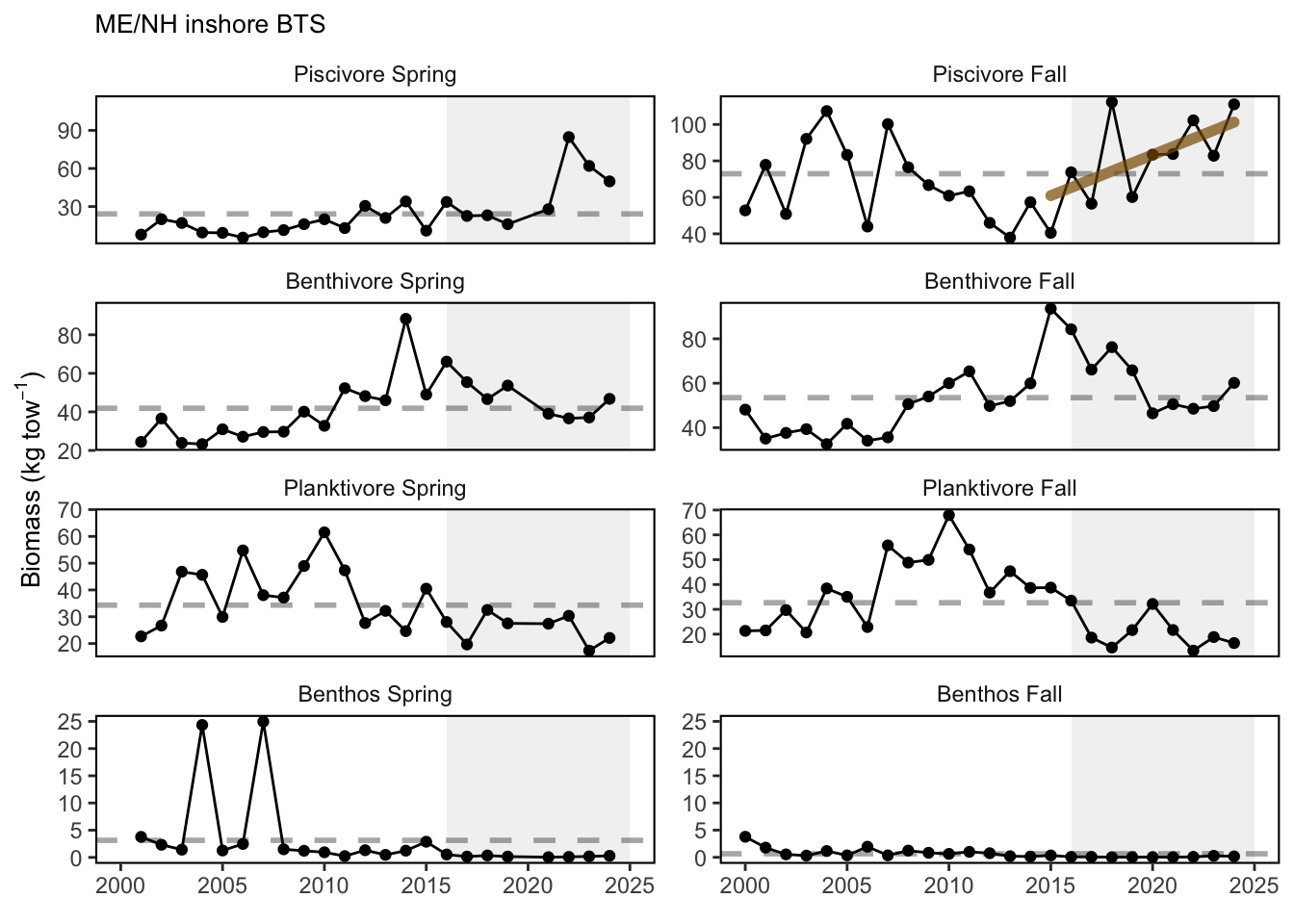
Indicators from these inshore surveys are analogous to those produced by the NEFSC trawl survey in the aggregate survey biomass indicator dataset.
2.2.2 What implications of the indicators are currently listed?
The trends in the Maine/New Hampshire inshore survey vary compared to the NEFSC survey. This is driven by different species availability to surveys in time and space as well as the surveys sampling different habitats. Nearshore habitats are important to fish and fisheries so we monitor them as as well as trends from the larger EPUs.
2.2.4 Have the indicators been tested to ensure they respond proportionally to a change in the underlying process?
No
3 SMART rating
Category | Indicator | Element | Attribute | Rating | ElementRating | OverallRating |
|---|---|---|---|---|---|---|
Fish | Inshore Survey (New England) | Specific | Described | 1 | 0.6666667 | 0.5666667 |
Fish | Inshore Survey (New England) | Specific | Units | 1 | 0.6666667 | 0.5666667 |
Fish | Inshore Survey (New England) | Specific | Spatial | 1 | 0.6666667 | 0.5666667 |
Fish | Inshore Survey (New England) | Specific | Uncertainty | 0 | 0.6666667 | 0.5666667 |
Fish | Inshore Survey (New England) | Specific | Methods | 1 | 0.6666667 | 0.5666667 |
Fish | Inshore Survey (New England) | Specific | Code | 0 | 0.6666667 | 0.5666667 |
Fish | Inshore Survey (New England) | Measurable | Available | 1 | 0.5000000 | 0.5666667 |
Fish | Inshore Survey (New England) | Measurable | Online | 1 | 0.5000000 | 0.5666667 |
Fish | Inshore Survey (New England) | Measurable | Contact | 1 | 0.5000000 | 0.5666667 |
Fish | Inshore Survey (New England) | Measurable | SourceDat | 0 | 0.5000000 | 0.5666667 |
Fish | Inshore Survey (New England) | Measurable | SourceAvail | 0 | 0.5000000 | 0.5666667 |
Fish | Inshore Survey (New England) | Measurable | SourceContact | 0 | 0.5000000 | 0.5666667 |
Fish | Inshore Survey (New England) | Achievable | Tested | 0 | 0.0000000 | 0.5666667 |
Fish | Inshore Survey (New England) | Achievable | Sensitivity | 0 | 0.0000000 | 0.5666667 |
Fish | Inshore Survey (New England) | Achievable | TimeLag | 0 | 0.0000000 | 0.5666667 |
Fish | Inshore Survey (New England) | Relevant | Advice | 1 | 0.6666667 | 0.5666667 |
Fish | Inshore Survey (New England) | Relevant | Implications | 1 | 0.6666667 | 0.5666667 |
Fish | Inshore Survey (New England) | Relevant | TargThresh | 0 | 0.6666667 | 0.5666667 |
Fish | Inshore Survey (New England) | Timebound | Frequency | 1 | 1.0000000 | 0.5666667 |
Fish | Inshore Survey (New England) | Timebound | Updated | 1 | 1.0000000 | 0.5666667 |
3.1 Comments
[Fill below by hand once above data complete]
3.1.1 Additional potential links to management in addition to uses listed above
3.1.2 What additional work would be needed for the Council to use the indicator?
3.1.3 What issues are caused if there is a gap or delay in data underlying the indicator