SMART Indicator Report: Atlantic MultiDecadal Oscillation Index
1 Descriptive Section
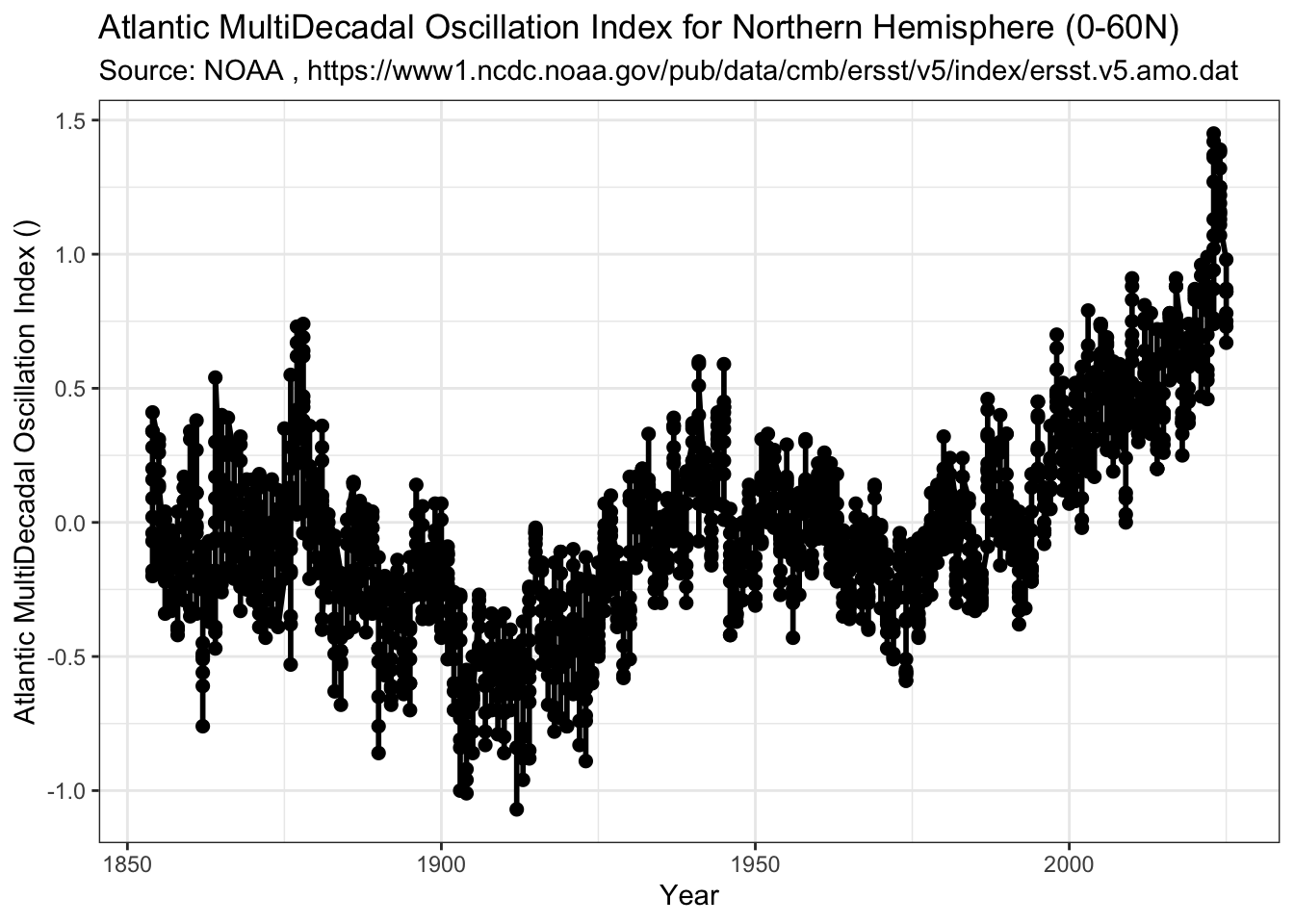
2 SMART Attribute Section
2.1 Indicator documentation
2.1.1 Are indicators available for others to use (data downloadable)?
Yes
2.1.1.1 Where can indicators be found?
All marea indicators are here: https://github.com/MarEcosystemApproaches/marea
2.1.1.2 How often are they updated? Are future updates likely?
Updates appear to be monthly; the future is unknown
2.1.1.3 Who is the contact?
Jamie C. Tam jamie.tam@dfo-mpo.gc.ca
2.1.2 Gather indicator statistics
2.1.2.2 Length of time series, start and end date, periodicity
General overview: Annual and Monthly
Indicator specifics:
Indicator | EPU | StartYear | EndYear |
|---|---|---|---|
Atlantic MultiDecadal Oscillation Index | Northern Hemisphere (0-60N) | 1854 | 2025 |
2.1.2.3 Spatial location, scale and extent
General overview: North Atlantic
Indicator specifics:
Indicator | EPU |
|---|---|
Atlantic MultiDecadal Oscillation Index | Northern Hemisphere (0-60N) |
2.1.3 Are methods clearly documented to obtain source data and calculate indicators?
No methods documentation is provided
2.1.4 Are indicator underlying source data linked or easy to find?
## Yes. Source information included: NOAA , https://www1.ncdc.noaa.gov/pub/data/cmb/ersst/v5/index/ersst.v5.amo.dat2.1.4.1 Where are source data stored?
## Source data stored at NOAA , https://www1.ncdc.noaa.gov/pub/data/cmb/ersst/v5/index/ersst.v5.amo.dat2.2 Indicator analysis/testing or history of use
2.2.2 What implications of the indicators are currently listed?
The AMO was originally described as “an internal oscillation in the climate system resulting from interactions between North Atlantic ocean currents and wind patterns.” If it were an internal oscillation, it could theoretically be predicted and therefore potentially useful for forecasting. It is now thought to be “an artifact, during the historical era, of competing anthropogenic (greenhouse warming and sulphate aerosol cooling) drivers and, during the pre-historic era, an artifact of the fact that volcanic forcing happens to have displayed a roughly multidecadal pacing in past centuries.” See https://michaelmann.net/the-rise-and-fall-of-the-atlantic-multidecadal-oscillation/
2.2.4 Have the indicators been tested to ensure they respond proportionally to a change in the underlying process?
Yes, the has been extensively tested using recent climate models to determine whether it is an internal climate system oscillation or not; the current conclusion is that it is not.
3 SMART rating
Category | Indicator | Element | Attribute | Rating | ElementRating | OverallRating |
|---|---|---|---|---|---|---|
Habitat-Physical | Atlantic MultiDecadal Oscillation Index | Specific | Described | 1 | 0.3333333 | 0.5 |
Habitat-Physical | Atlantic MultiDecadal Oscillation Index | Specific | Units | 0 | 0.3333333 | 0.5 |
Habitat-Physical | Atlantic MultiDecadal Oscillation Index | Specific | Spatial | 1 | 0.3333333 | 0.5 |
Habitat-Physical | Atlantic MultiDecadal Oscillation Index | Specific | Uncertainty | 0 | 0.3333333 | 0.5 |
Habitat-Physical | Atlantic MultiDecadal Oscillation Index | Specific | Methods | 0 | 0.3333333 | 0.5 |
Habitat-Physical | Atlantic MultiDecadal Oscillation Index | Specific | Code | 0 | 0.3333333 | 0.5 |
Habitat-Physical | Atlantic MultiDecadal Oscillation Index | Measurable | Available | 1 | 0.8333333 | 0.5 |
Habitat-Physical | Atlantic MultiDecadal Oscillation Index | Measurable | Online | 1 | 0.8333333 | 0.5 |
Habitat-Physical | Atlantic MultiDecadal Oscillation Index | Measurable | Contact | 1 | 0.8333333 | 0.5 |
Habitat-Physical | Atlantic MultiDecadal Oscillation Index | Measurable | SourceDat | 1 | 0.8333333 | 0.5 |
Habitat-Physical | Atlantic MultiDecadal Oscillation Index | Measurable | SourceAvail | 1 | 0.8333333 | 0.5 |
Habitat-Physical | Atlantic MultiDecadal Oscillation Index | Measurable | SourceContact | 0 | 0.8333333 | 0.5 |
Habitat-Physical | Atlantic MultiDecadal Oscillation Index | Achievable | Tested | 1 | 0.3333333 | 0.5 |
Habitat-Physical | Atlantic MultiDecadal Oscillation Index | Achievable | Sensitivity | 0 | 0.3333333 | 0.5 |
Habitat-Physical | Atlantic MultiDecadal Oscillation Index | Achievable | TimeLag | 0 | 0.3333333 | 0.5 |
Habitat-Physical | Atlantic MultiDecadal Oscillation Index | Relevant | Advice | 0 | 0.0000000 | 0.5 |
Habitat-Physical | Atlantic MultiDecadal Oscillation Index | Relevant | Implications | 0 | 0.0000000 | 0.5 |
Habitat-Physical | Atlantic MultiDecadal Oscillation Index | Relevant | TargThresh | 0 | 0.0000000 | 0.5 |
Habitat-Physical | Atlantic MultiDecadal Oscillation Index | Timebound | Frequency | 1 | 1.0000000 | 0.5 |
Habitat-Physical | Atlantic MultiDecadal Oscillation Index | Timebound | Updated | 1 | 1.0000000 | 0.5 |
3.1 Comments
3.1.1 Additional potential links to management in addition to uses listed above
[Select from list of management processes/actions using exact keywords]
3.1.2 What additional work would be needed for the Council to use the indicator?
[List current gaps in the indicator given the current or potentail uses listed above, what resources are needed?]
3.1.3 What issues are caused if there is a gap or delay in data underlying the indicator
[Link to management process/actions and their requirements]